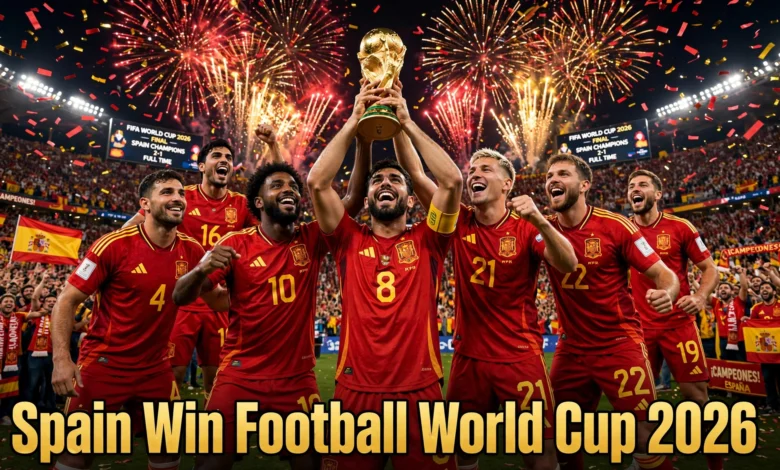
Spain beat Argentina to win the 2026 FIFA World Cup, claiming their second world title in a tense, absorbing final played on July 19, 2026, at the New York New Jersey Stadium in East Rutherford. A single goal from substitute Ferran Torres in the 106th minute was all it took to end Argentina’s reign as world champions and deliver a moment the whole of Spain will never forget.
For the Spain national football team, this was more than just a trophy. It was confirmation that this generation — led by a 19-year-old wunderkind named Lamine Yamal and anchored by the relentless midfield engine of Rodri — belongs among the greatest sides in football history. They went through the entire tournament having conceded just one goal, and in the final, they didn’t allow Argentina a single shot on target during 90 minutes of regular time.
For Argentina and Lionel Messi, it was heartbreak. The 39-year-old left the field in tears, his dream of defending the title he won so emotionally in Qatar 2022 slipping away in the longest possible fashion. He registered just 15 touches. His team managed only two shots across 120 minutes.
This is the full story of how Spain became world champions again.
Spain Beat Argentina: How the 2026 World Cup Final Unfolded
A Match Spain Dominated from the First Whistle
From the opening minute, Spain’s dominance was clear. Under coach Luis de la Fuente, La Roja set up with their trademark high press and relentless ball circulation, suffocating Argentina’s build-up play before it could ever find rhythm.
Argentina didn’t take a single shot in the first half and had zero touches inside the Spanish box. Messi only registered 15 touches, compared to 26 for Lamine Yamal. That stat alone tells you everything about how lopsided the final was in terms of control and possession.
Spain had 60% possession throughout the match and racked up 20 shots in total. Argentina, one of the most feared attacking sides in world football, managed just two. The expected goals (xG) figures were equally brutal: Spain had 1.94 expected goals from their chances, while Argentina managed just 0.20 from the minimal chances they created.
Emiliano Martinez: The Wall That Couldn’t Hold Forever
What kept Argentina in the match was an extraordinary performance from goalkeeper Emiliano Martinez. The Aston Villa shot-stopper produced save after save, denying Spain repeatedly and — for long stretches — keeping Argentina’s title defense alive through sheer will and brilliance.
By stoppage time, Martinez had broken the championship-game record of eight saves, and he finished with 11 — a World Cup final record.

It was the kind of goalkeeping display that deserved to win a match. But football has a cruel streak, and when Enzo Fernandez was sent off for a second bookable offense in second-half stoppage time, Argentina’s resistance began to crack.
The Red Card That Changed Everything
Enzo Fernandez’s dismissal in the 90th minute was the turning point of the final. With Argentina reduced to ten men, Spain, with a man advantage, continued to invade the Argentine defence.
Argentina, for all their grit and late-game heroics that had defined their tournament run, suddenly had a mountain too steep to climb. Ten men, extra time, and the most suffocating pressing team on the planet bearing down on them.
Ferran Torres: The Hero Who Came Off the Bench
The Goal That Won the World Cup
The decisive moment came 37 seconds into the second half of extra time — the 106th minute of the match. Torres pounced on a bouncing ball in the box and used his left foot to bury a shot just under the crossbar and into the back of the net.
The build-up was vintage Spain. Lamine Yamal beat two defenders and saved the ball from crossing the end line before crossing to substitute Ferran Torres for a close-range header directly at Martinez — but on the follow-up, Torres was clinical.
Torres became only the fifth substitute to score in a World Cup final, and the first since Mario Götze scored for Germany in 2014 — whose goal also won the final, also against Argentina. The symmetry is almost poetic.
After the match, Torres spoke with characteristic humility and passion. “It was a goal scored by 47 million people,” Torres said, referring to Spain’s population. “When you have Messi on the other side, well, you are nervous. At the end of the day, we always depended on us. We always come up with our football, and we showed it again.”
A Perfect Tournament Ending for a Substitute Hero
Ferran Torres hadn’t scored a single goal before the final in this World Cup campaign. He came off the bench in the 62nd minute and changed the game entirely. It’s a reminder of what squad depth means at this level — every player ready, every player believing, every player capable of writing history when called upon.
Lamine Yamal: The 19-Year-Old Who Conquered the World
A Generational Talent Delivers on the Biggest Stage
If there was one player who embodied Spain’s footballing identity throughout this World Cup, it was Lamine Yamal. The Barcelona teenager, now 19, was electric in the final — his pace, dribbling, and vision constantly creating problems for Argentina’s backline.
As the 19-year-old Yamal had the last laugh in the clash of generations, Lionel Messi was left gutted. In many ways, the final felt like a passing of the torch — the twilight of Messi’s era and the very beginning of Yamal’s.
Lamine Yamal became the youngest player to be both a European and World champion. He won Euro 2024 with Spain when he was 16, and now — before his 20th birthday — he has a FIFA World Cup winner’s medal around his neck too.
When Spain won the 2010 World Cup, Lamine Yamal was only three years old. Now the 19-year-old Barcelona star can add a World Cup title to his already impressive résumé. In the intervening 16 years, Spanish football went through peaks and valleys. With Yamal leading the next generation, the peaks may be just beginning again.
Spain’s Historic Tournament Run: Conceding Just One Goal
The Most Dominant Side in the World Cup
Spain’s 2026 World Cup campaign was nothing short of historic. Spain was in control throughout the match on Sunday, not allowing a single shot on goal by Argentina. It was the continuation of a suffocating defensive effort, as Spain conceded only one goal the entire World Cup.
Think about what that means across seven matches — including knockout games against some of the best teams in the world. One goal conceded. It is the kind of defensive record that belongs alongside the greatest World Cup performances of all time.
Their approach under Luis de la Fuente was ruthless and systematic:
- Pressing high to win the ball back in advanced positions
- Dominating possession and controlling tempo
- Rotating quality across a deep squad rather than relying on one superstar
- Flexible formations that adapted to each opponent while maintaining the same DNA
De la Fuente’s side dominated this final from start to finish, and he is now the oldest manager to win the World Cup. His record since taking charge of Spain is extraordinary: he is 14-0-1 as the team’s manager in competitive matches.
Key Players Who Made It Happen
Spain’s success was never about one man. It was a collective effort built on trust, depth, and tactical intelligence. Several players stand out across the tournament:
- Rodri — The midfield anchor who controlled the pace of every game. After his dominant midfield display in the final, Spain captain Rodri claimed the FIFA World Cup Golden Ball.
- Unai Simon — The goalkeeper who conceded just one goal and is widely expected to take home the Golden Glove award.
- Mikel Oyarzabal — The striker who finished as one of the tournament’s top scorers with five goals before being taken off in the second half of the final.
- Pedri — Came on as a substitute and provided class and composure when Spain needed it most.
- Marc Cucurella — An aggressive, energetic presence on the left who helped Spain create multiple late chances.
Argentina’s World Cup Defense Ends: Messi Bows Out in Tears
The End of an Era
For all the joy in the Spanish camp, the other side of this story is one of genuine sadness. Lionel Messi, arguably the greatest player the game has ever seen, played his final World Cup match on Sunday. He walked off the pitch in tears.
The defeat was especially poignant for Lionel Messi, who left the field in tears after collecting his runners-up medal in what is expected to be his final World Cup appearance.
Argentina entered the 2026 World Cup trying to be the first team to win four straight major tournaments. Argentina had won Copa América in 2021 and 2024 sandwiched around the 2022 World Cup. They came agonizingly close to history. Instead, it ended with Messi on a losing side, barely able to touch the ball in the match that mattered most.
His best moment came just five minutes in. Julián Álvarez led Messi with a pass, and Messi sprinted for the ball, but goalkeeper Unai Simón beat him to the spot and kicked the ball away. After that, he faded from the game almost entirely.
Messi has hinted this would be his last World Cup. He will be 43 by the time the 2030 tournament arrives. For now, there is perhaps still a chance he suits up for the next Copa America tournament, which will be held in 2028. But Sunday felt like a final farewell on the biggest stage.
Whatever comes next, his legacy is untouchable. Two World Cups (as runner-up in 2014 and 2022 champion), eight Ballon d’Or awards, countless trophies for club and country. Even Messi will concede Spain were worthy winners.
Spain vs Argentina 2026 Final: Key Stats and Numbers
The numbers from the final paint a complete picture of Spain’s dominance:
| Stat | Spain | Argentina |
|---|---|---|
| Goals | 1 | 0 |
| Possession | 60% | 32% |
| Shots | 20 | 2 |
| Shots on Target | 12 | 0 |
| Expected Goals (xG) | 1.94 | 0.20 |
| Passes | — | — |
| Emiliano Martinez Saves | — | 11 (record) |
These figures reinforce one clear truth: Spain deserved to win. The scoreline of 1-0 flatters Argentina. This was a comprehensive performance that happened to be decided by a single goal in extra time.
The Bigger Picture: Spain’s Dynasty Is Back
Back-to-Back Titles Already on the Horizon?
With Argentina’s loss, we still haven’t seen a country win back-to-back World Cups since Brazil in 1958 and 1962. Now it’s Spain’s opportunity to win two in a row in 2030.
It sounds ambitious, but look at the facts. With Spain now holding the World Cup trophy along with the 2024 European Championship title, this generation is poised for its own dynastic run similar to when La Roja won three major trophies — one World Cup and two Euros — from 2008 to 2012.
The core of this team is young. Yamal won’t even be 23 by the time the 2030 World Cup arrives. Pedri, Gavi, Cucurella, and most of the squad will still be in their prime years. If they stay healthy and hungry, there is no reason why this cannot be the beginning of something historic.
For a deeper look at how Spain’s tactical approach made them unstoppable in this tournament, The Analyst’s full tactical breakdown of Spain vs Argentina provides excellent context on the numbers behind the performance.
The 2026 World Cup as a Global Event
This World Cup was historic beyond just Spain’s triumph. Co-hosted by the United States, Canada, and Mexico, it was the first edition with 48 teams and the expanded format delivered some extraordinary football throughout.
U.S. President Donald Trump joined FIFA President Gianni Infantino for the medal and trophy presentation, while the leaders of fellow co-hosts Canada and Mexico attended the final. Trump and Infantino were booed during the ceremony.
The halftime show was a cultural event in itself. Shakira, Madonna, BTS, Justin Bieber, and Burna Boy took the stage during an extended break curated by Coldplay’s Chris Martin. It was the first Super Bowl-style halftime performance at a World Cup final, and it delivered on every level.
For complete official match statistics and tournament records, you can visit the official FIFA match centre page for the 2026 World Cup final.
Award Winners from the 2026 FIFA World Cup
Before the trophy was lifted, FIFA handed out the individual awards:
- Golden Ball (Best Player): Rodri (Spain) — for his commanding midfield performances throughout the tournament
- Golden Boot (Top Scorer): Kylian Mbappé — who won his second Golden Boot with ten goals, even though France did not reach the final
- Golden Glove (Best Goalkeeper): Unai Simon (Spain) — expected to confirm the award after his record-low goals conceded
- Best Young Player: Lamine Yamal (Spain) — youngest player to win both the Euros and the World Cup
What This Win Means for Spanish Football
There is a weight to this moment that goes beyond the scoreline. Spain last won the World Cup in South Africa in 2010 — a tournament defined by Andrés Iniesta’s extra-time winner in the final against the Netherlands. The generation that produced Xavi, Iniesta, David Villa, and Casillas gave way to a difficult decade where Spain never quite recaptured that standard on the global stage.
But under de la Fuente, with a new generation of players who grew up watching that golden era, Spain found a way to build something equally special. They won Euro 2024. They entered this World Cup as one of the favorites. And they delivered.
The fact that they did it with just one goal conceded across the entire tournament speaks to a balance that the 2008–2012 side, as brilliant as it was, didn’t always achieve. This Spain defends as well as it attacks. It presses as well as it passes. And when it needed a goal in the biggest game of all, a substitute came off the bench and scored 37 seconds into the second half of extra time.
That’s not luck. That’s a team that genuinely believed in every single player in its squad.
Conclusion
Spain beat Argentina in one of the most tactically complete World Cup final performances in the modern era, winning the 2026 FIFA World Cup 1-0 thanks to Ferran Torres’ extra-time goal at the New York New Jersey Stadium on July 19, 2026. With Lamine Yamal dazzling a global audience, Rodri commanding midfield and earning the Golden Ball, and goalkeeper Unai Simon conceding just one goal across the entire tournament, Luis de la Fuente’s side proved they are not just champions — they are a dynasty in the making. For Lionel Messi and Argentina, it was a bittersweet end to a golden era, with the great man leaving in tears in what is widely expected to be his final World Cup. Football moves on, the trophy belongs to Spain, and the sport now looks ahead to 2030 with La Roja once again the team everyone will be trying to beat.